A new survey from the American Chamber of Commerce to the EU (AmCham EU) and the U.S. Chamber of Commerce reports that the transatlantic trade and investment relationship hit record-breaking numbers in 2021. The findings come out against a difficult political and economic backdrop, with the war raging in Ukraine and after two years of the COVID-19 pandemic. Inflation, congested supply chains, scarcity of raw materials and energy prices also add to global uncertainty. Despite this, the report demonstrates the resilience of the transatlantic economy and outlines avenues to strengthen the EU-US partnership with initiatives such as the Trade and Technology Council. To download the study, please click here.
2021 was a record-breaking year for the transatlantic economy, new report shows
A new survey from the American Chamber of Commerce to the EU (AmCham EU) and the U.S. Chamber of Commerce reports that the transatlantic trade and investment relationship hit record-breaking numbers in 2021. The findings come out against a difficult political and economic backdrop, with the war raging in Ukraine and after two years of the COVID-19 pandemic. Inflation, congested supply chains, scarcity of raw materials and energy prices also add to global uncertainty. Despite this, the report demonstrates the resilience of the transatlantic economy and outlines avenues to strengthen the EU-US partnership with initiatives such as the Trade and Technology Council. To download the study, please click here.
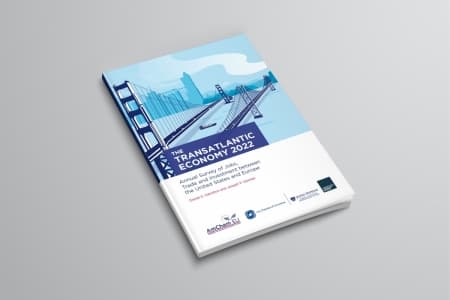
The Transatlantic Economy 2022 highlights how the EU-US relationship remains the largest of its kind in the world. The transatlantic economic partnership generates around €5.5 trillion ($6 trillion) in commercial sales a year and accounts for half of total global personal consumption. No place in the world attracts more US foreign direct investment (FDI) than Europe. Since the beginning of this decade, Europe has attracted 62.6% of total US global investment.
In 2021, transatlantic trade in goods reached €1 trillion ($1.1 trillion). US foreign direct investment (FDI) flows to Europe rose to €230 billion ($253 billion), while US foreign affiliate income earned in Europe amounted to an estimated €272 billion ($300 billion) – 2.7 times more than income earned in all of Asia.
What to look out for in this new edition?
How the war in Ukraine affects the US and European economies
What COVID-19, trade spats and congested supply chains mean for the transatlantic economy
How US-Europe commercial relations compare with those each has with China and others
Data on the rise of the transatlantic energy economy
Changing dynamics of post-Brexit relations with the UK
Individual profiles for 30 European countries and all 50 US states
The research was conducted independently by Daniel Hamilton and Joseph Quinlan at the Foreign Policy Institute, School of Advanced International Studies, Johns Hopkins University and the Transatlantic Leadership Network.
The data is also available on Thriving Together, an online platform that showcases the deep ties that bind Europe and the United States, including numbers from The Transatlantic Economy 2022. Visit the platform: thrivingtogether.eu.
The American Chambers of Commerce in Denmark, Finland, Greece, Ireland, Luxembourg and Sweden are partners of this year’s edition.
Related items
:focal())
News
3 Dec 2025
Meeting with Deputy Secretary Landau to advance transatlantic cooperation
On Tuesday, 2 December, AmCham EU took part in a roundtable discussion with Christopher Landau, US Deputy Secretary of State. With the implementation of the EU-US Framework Agreement moving forward, the discussions focused on building a more stable and competitive transatlantic business environment. Participants discussed the importance of an open Single Market and the urgency to move ahead with the EU’s work on simplification. The exchange also underlined the value of the transatlantic marketplace as a springboard for American companies to compete globally. Strengthening the partnership makes both sides more resilient and better positioned to respond to strategic challenges, including those posed by non-market economies.
:focal())
News
27 Nov 2025
Highlighting our financial services priorities in Frankfurt and Strasbourg
On Monday, 25 and Wednesday, 27 November 2025, AmCham EU travelled to Frankfurt, Germany and Strasbourg, France to support an ambitious Savings and Investment Union (SIU) that will allow the EU to gain momentum towards more integrated Single Market. In Frankfurt, members met with senior officials from the European Central Bank, Deutsche Bundesbank, as well as the International Financial Reporting Standards (IFRS) and the International Sustainability Standards Board (ISSB). Conversations focused on strengthening Europe’s place in the global financial markets and opportunities to streamline regulatory complexities.
The delegation then continued to the European Parliament in Strasbourg, where discussions with MEPs centred on securitsiation, the upcoming market integration package, next steps for the sustainable finance framework, the role of innovative technologies and the future of the digital euro. Throughout the visit, members emphasised the need to deepen Europe's capital markets, prevent further fragmentation, support innovation-driven regulation and foster a globally attractive investment environment that strengthens Europe’s financial resilience.
:focal())
News
27 Nov 2025
Advocating for open, rules-based trade in Strasbourg
On Tuesday, 25 and Wednesday, 26 November 2025, AmCham EU travelled to the European Parliament in Strasbourg, France. Over the two-day programme, the delegation met with nearly a dozen MEPs and advisors for an exchange on the future of EU trade policy. Discussions centred on the importance of transatlantic cooperation, the ratification of the EU-Mercosur agreement and the implementation of the EU-US Framework Agreement. Members underlined the need for an ambitious EU trade agenda that ensures market access, reduces tariff and non-tariff barriers and strengthens the resilience of European industry. The delegation also called for a swift adoption of the Commission’s proposal on tariff reduction on US industrial goods and reiterated the importance of a pragmatic, forward-looking transatlantic agenda that promotes predictability and economic security.
Policy priorities
Insights and advocacy driving Europe’s policy agenda. Our priorities support growth, innovation and a stronger transatlantic economy.
Membership
Connecting business and policymakers to strengthen the voice of American companies in Europe.