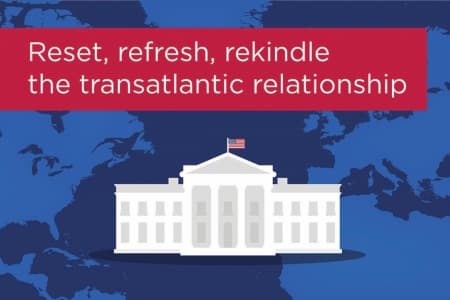
Reset, refresh, rekindle: for a new approach to the transatlantic relationship

Opinion by Susan Danger, CEO, AmCham EU

As from 20 January 2021, President Joe Biden has taken office as the 46th President of the United States. The election itself saw the greatest voter turnout in the history of the US. This was an important reaffirmation of democracy. In the aftermath of this most fiercely contested election, the shocking and disturbing scenes from the Capitol Building on the day of the certification of the election results will serve as a reminder to President Biden that his principal task must now be to unify the country, alongside mapping the path to recovery from the COVID-19 pandemic.

News
19 Jan 2021
Transatlantic
Reset, refresh, rekindle: for a new approach to the transatlantic relationship

Opinion by Susan Danger, CEO, AmCham EU

As from 20 January 2021, President Joe Biden has taken office as the 46th President of the United States. The election itself saw the greatest voter turnout in the history of the US. This was an important reaffirmation of democracy. In the aftermath of this most fiercely contested election, the shocking and disturbing scenes from the Capitol Building on the day of the certification of the election results will serve as a reminder to President Biden that his principal task must now be to unify the country, alongside mapping the path to recovery from the COVID-19 pandemic.

Beyond the domestic political arena, another area where unity must prevail is in the transatlantic relationship. Under strain since the negotiations on a Transatlantic Trade and Investment Partnership (TTIP) ended in stalemate, tensions have flared and threats of tariffs have foreshadowed cooperation. As CEO of the American Chamber of Commerce to the European Union, I call on the US and the EU to use the new presidential term as an opportunity to ‘reset, refresh and rekindle’ the transatlantic agenda.

Reset transatlantic relations

With President Biden now at the helm, both sides must seize the chance to reset the relationship and focus not on that which divides us, but that which unites. The EU-US economic relationship supports 16 million jobs on both sides of the Atlantic. It is worth one third of global GDP and accounts for half of global personal consumption. It is the largest economic relationship in the world. Both sides can surely agree that now is the time to dial back the adversarialism in favour of constructive proposals to rediscover common ground. The EU and the US should seek out sectors where barriers to trade and investment can be stripped away relatively easily (ie, manufacturing). The limited tariff reduction agreement concluded over the summer is a good example of avenues to advance a positive agenda. Both sides should certainly continue to seek opportunities to cooperate on emerging issues (ie, artificial intelligence) where they can lead the way in setting global standards. A high-level EU-US summit early into the new administration’s term would set the tone, by sending a message that both sides consider this partnership a priority.

Refresh multilateralism

Across the world, there has been a trend in recent years towards policies that put domestic interests first. However, prioritising the domestic at the expense of the international is short-sighted in the interconnected and globalised economy that we have built. In the face of common problems, including a global pandemic, or a climate crisis, no nation can absolve itself of its responsibility to engage with the wider world. For global challenges, we need global solutions – and to find such solutions, we require multilateral fora. As a business community, we agree that multilateral institutions such as the World Trade Organization (WTO) are imperfect in their current form. These institutions must be refreshed in order to make them fit for purpose in the twenty-first century. The US must engage constructively from within these institutions and alongside its partners and allies in Europe and beyond to shape this modernisation process. A good first step would be to resolve the stalemate surrounding the appointment of the WTO’s next Director-General.

Rekindle EU-US leadership

The EU and the US are bound by a common history, common democratic values and a sense of common destiny. Throughout their common history, Americans and Europeans have stood shoulder to shoulder to fight for a better future. In the current context, our societies face a host of new challenges. A geopolitical challenge in the form of China; an existential challenge by way of the climate emergency, and the need to adapt our economies to cleaner and more sustainable living; and a technological challenge as the digitalisation of our economies and societies becomes ever more far-reaching. The EU and the US must work together to coordinate their approach to these societal challenges. Together, they can use their combined economic weight to set global standards. Together, they can leverage their common democratic values to shape global governance structures. Together, they can lead the fight for a more sustainable and more prosperous future. Now more than ever we must rekindle EU-US leadership, lest rival geopolitical powers step in to fill the void.

As American businesses invested in and committed to Europe, we want to see the strongest possible transatlantic relationship. This is good for business; it is good for citizens; and it is good for our societies. A strong, outward-looking transatlantic relationship is the lynchpin to a prosperous and deeply interconnected global economy. The EU’s recently published proposal for ‘a new transatlantic agenda for global change’ recognises that the new US administration represents an opportunity to reset, refresh and rekindle our relationship. Each side must grasp it with both hands.
Related items

News
3 Dec 2025

Meeting with Deputy Secretary Landau to advance transatlantic cooperation

On Tuesday, 2 December, AmCham EU took part in a roundtable discussion with Christopher Landau, US Deputy Secretary of State. With the implementation of the EU-US Framework Agreement moving forward, the discussions focused on building a more stable and competitive transatlantic business environment. Participants discussed the importance of an open Single Market and the urgency to move ahead with the EU’s work on simplification. The exchange also underlined the value of the transatlantic marketplace as a springboard for American companies to compete globally. Strengthening the partnership makes both sides more resilient and better positioned to respond to strategic challenges, including those posed by non-market economies.

Transatlantic
Read more
Read more about Meeting with Deputy Secretary Landau to advance transatlantic cooperation
News
21 Nov 2025

AmCham EU meets with Ambassadors Greer, Puzder and White

On Friday, 21 November AmCham EU joined Ambassadors Jamieson Greer, United States Trade Representative, Andrew Puzder, US Ambassador to the European Union and Bill White, US Ambassador to the Kingdom of Belgium. During the discussion, Malte Lohan, CEO, AmCham EU voiced strong support for the EU-US Framework Agreement, which offers the best path to improve the trade and investment climate, while addressing concerns about the economic impact of broad tariffs. AmCham EU continues to support other key parts of the deal, as well as calling on the European Parliament and Council to quickly adopt the Commission’s tariff reduction proposals with minimal changes.  

Transatlantic
Read more
Read more about AmCham EU meets with Ambassadors Greer, Puzder and White
News
9 Nov 2025

Tackling competitiveness with our Executive Council

Urgency around simplification, predictability for businesses and the growing disconnect between political narrative and business reality were centre stage during AmCham EU’s Executive Council (ExCo) Fall plenary on Monday, 3 and Tuesday, 4 November in Brussels. With a view from the boardroom of some of the largest companies invested in Europe, the senior leaders emphasised how complex and overlapping rules are making it harder to plan, invest and grow in the region. They stressed that the current focus on adding new requirements is not matched by efforts to reduce or align existing ones. The result is a business environment that feels increasingly unpredictable, despite policy goals aimed at growth and competitiveness. 

Julie Linn Teigland, Chair, Executive Council, AmCham EU, said: ‘The ExCo was encouraged by the earnest and determined focus of simplification agenda and how both Commission and Council are putting competitiveness at the centre of EU policy making. The way forward is to set ambitious goals and deliver on them. We truly believe that Europe has the right capabilities and potential to stay an attractive place for investment, growth and innovation.’ 

In meetings with senior EU and US officials, including Ambassador Carsten Grønbech-Jensen, Permanent Representation of Denmark to the EU; Ambassador Aingeal O’Donoghue, Permanent Representation of Ireland to the EU; Ambassador Andrew Puzder, US Mission to the EU and Björn Seibert, Head of Cabinet to European Commission President Ursula von der Leyen, the group of business leaders reinforced the call for clearer, more consistent regulation and a renewed commitment to strengthening the Single Market. Underpinning the discussion was the need for progress on the EU-US Framework agreement, one that provides a path to predictability for businesses. 

Europe must act now to safeguard its competitiveness. That means cutting complexity, ensuring policy matches business reality and deepening ties with trusted partners. If Europe wants to lead on innovation, sustainability and security, it must first be a place where business can thrive. 

Simplification
Transatlantic
Read more
Read more about Tackling competitiveness with our Executive Council