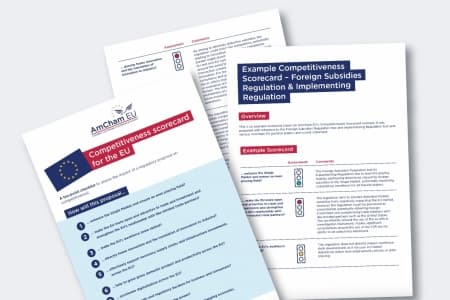
Competitiveness is a hot topic. But with Europe's attractiveness under threat, the EU needs to reset the agenda. Part of this is addressing how EU policy measures are made, as well as the substance of those proposals. To solve this, we have developed a Competitiveness Scorecard that features a simple yet effective ten-point checklist to evaluate new or revised regulations. By enhancing transparency, incorporating broad stakeholder insights and directly addressing key competitiveness factors, the Scorecard is a concrete way to significantly improve the quality and effectiveness of EU regulatory proposals. Learn more about the Competitiveness Scorecard in our latest blog.
Taking score of competitiveness in policymaking
Related items
:focal())
News
9 Dec 2025
Omnibus I: the EU shows it can deliver on simplification, but global firms need further certainty
The Omnibus I political agreement announced yesterday broadly eases the sustainability compliance and due diligence burden for businesses under the Corporate Sustainability Due Diligence Directive (CSDDD) and the Corporate Sustainability Reporting Directive (CSRD), giving much-needed certainty to businesses. It is a significant achievement for the EU’s simplification agenda and ongoing efforts to reduce the regulatory burden. Specifically, the flexibility introduced in terms of the risk-based approach and how companies need to define adverse impacts will alleviate most of the excessive burden that existed under the original CSDDD. The revised transposition timeline of CSDDD to 2029 will also give all parties the necessary time to prepare for implementation.
However, it appears that EU policymakers did not yet sufficiently tackle how these rules apply to the global activities of companies and groups – for example, by limiting the scope of the CSDDD to only those products and services with a logical link to the EU. This is a missed opportunity with far-reaching consequences that keeps legal uncertainty in place for global firms and their supply chains. This oversight on extraterritorial impact will make the CSDDD more difficult for policymakers to implement and monitor and risks creating confusing overlap with other jurisdictions’ rules.
The EU must use the next steps in the policy-making process – including implementing measures, guidance and future reviews – to fix outstanding challenges in both the CSDDD and the CSRD. In particular, clearer rules on when and how EU legislation impacts global business activities would give companies the predictability they need to invest and support sustainability investments.
:focal())
News
20 Nov 2025
Digital Omnibus: a strong first step, but more room for harmonisation
The European Commission’s newly introduced Digital Omnibus package is a good starting point for the EU’s digital simplification. Measures such as adjusting the timeline for the application of high-risk AI rules and a reinforced role for the European AI Office are tangible improvements that will give businesses more certainty about how and when they need to meet their compliance obligations. Similarly, the Commission’s launch of a Digital Fitness Check to stress test the digital rulebook and a Data Union Strategy to unlock high-quality data for AI development are important steps.
However, in certain areas the Commission’s proposal does not go far enough, especially in the harmonisation of cybersecurity obligations. A single entry point for incident reporting helps, but duplication and fragmentation persist across the Network and Information Security Systems Directive 2, the Cyber Resilience Act, the Digital Operational Resilience Act and the General Data Protection Regulation. To cut costs for businesses while raising cyber resilience, the Omnibus should also:
Harmonise taxonomies, thresholds and timelines
Expand the main establishment principle
Align certification and conformity assessments to avoid double audits
Lessons from other Omnibus initiatives underscore the need for the co-legislators to take swift action and ensure reliable political support behind the Commission’s competitiveness agenda. The stakes for the Digital Omnibus are Single Market-wide. Manufacturers, healthcare and life sciences, financial services, mobility, energy and retail all rely on digital technologies and all face unnecessary burdens from overlapping digital rules. Targeted simplification that reduces duplication and clarifies enforcement promises to accelerate AI adoption, bolster cyber resilience and free resources for investment and jobs across Europe.
For more detailed recommendations, read our Digital Omnibus position paper.
:focal())
News
9 Nov 2025
Tackling competitiveness with our Executive Council
Urgency around simplification, predictability for businesses and the growing disconnect between political narrative and business reality were centre stage during AmCham EU’s Executive Council (ExCo) Fall plenary on Monday, 3 and Tuesday, 4 November in Brussels. With a view from the boardroom of some of the largest companies invested in Europe, the senior leaders emphasised how complex and overlapping rules are making it harder to plan, invest and grow in the region. They stressed that the current focus on adding new requirements is not matched by efforts to reduce or align existing ones. The result is a business environment that feels increasingly unpredictable, despite policy goals aimed at growth and competitiveness.
Julie Linn Teigland, Chair, Executive Council, AmCham EU, said: ‘The ExCo was encouraged by the earnest and determined focus of simplification agenda and how both Commission and Council are putting competitiveness at the centre of EU policy making. The way forward is to set ambitious goals and deliver on them. We truly believe that Europe has the right capabilities and potential to stay an attractive place for investment, growth and innovation.’
In meetings with senior EU and US officials, including Ambassador Carsten Grønbech-Jensen, Permanent Representation of Denmark to the EU; Ambassador Aingeal O’Donoghue, Permanent Representation of Ireland to the EU; Ambassador Andrew Puzder, US Mission to the EU and Björn Seibert, Head of Cabinet to European Commission President Ursula von der Leyen, the group of business leaders reinforced the call for clearer, more consistent regulation and a renewed commitment to strengthening the Single Market. Underpinning the discussion was the need for progress on the EU-US Framework agreement, one that provides a path to predictability for businesses.
Europe must act now to safeguard its competitiveness. That means cutting complexity, ensuring policy matches business reality and deepening ties with trusted partners. If Europe wants to lead on innovation, sustainability and security, it must first be a place where business can thrive.
Policy priorities
Insights and advocacy driving Europe’s policy agenda. Our priorities support growth, innovation and a stronger transatlantic economy.
Membership
Connecting business and policymakers to strengthen the voice of American companies in Europe.