This year’s Transatlantic Conference, ‘Thriving together: uniting in the face of global challenges’ put industry and institutions in the same room to discuss the importance of a strong and united transatlantic relationship, especially on the green and digital transitions. The conference took place on Wednesday, 22 March 2023 and featured speakers from both sides of the Atlantic. As an opening video, Gina Raimondo, US Secretary of Commerce, underlined the importance of keeping the transatlantic dialogue open through forums like the Trade and Technology Council. Michael Miebach, CEO, Mastercard, then expanded on why the focus should be on innovation, sustainability and inclusion to keep the EU and US competitive.
Transatlantic 2023: in review
This year’s Transatlantic Conference, ‘Thriving together: uniting in the face of global challenges’ put industry and institutions in the same room to discuss the importance of a strong and united transatlantic relationship, especially on the green and digital transitions. The conference took place on Wednesday, 22 March 2023 and featured speakers from both sides of the Atlantic. As an opening video, Gina Raimondo, US Secretary of Commerce, underlined the importance of keeping the transatlantic dialogue open through forums like the Trade and Technology Council. Michael Miebach, CEO, Mastercard, then expanded on why the focus should be on innovation, sustainability and inclusion to keep the EU and US competitive.
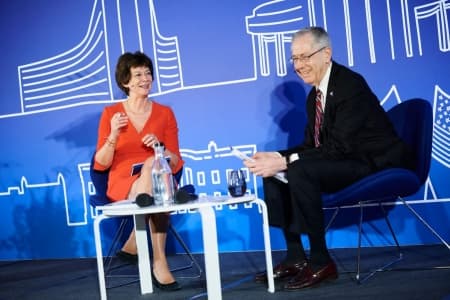
The conference included a series of panel discussions, diving into key priorities for the transatlantic relationship. First off was a conversation focused on how the EU and the US can navigate the difficult external environment. The panellists focused on transatlantic cooperation and the need to collaborate with industry in addressing shared issues. Afterwards, the conversation turned to the transatlantic economy. The speakers explained how to continue economic growth, the EU and US have to find global solutions to shared challenges.
Following the initial panel discussions, Daniel Hamilton and Joseph Quinlan presented the key findings of the Transatlantic Economy 2023 report, the annual survey of transatlantic jobs, trade and investment. This year’s edition features new insights into what impact energy transformations have had on the transatlantic partnership. The report also draws attention to trends like global supply chain issues and the need to diversify, relations with China and transatlantic data flows.
After the lunch and networking session, Mark Gitenstein, US Ambassador to the European Union, took to the stage to give his perspective on how the relationship between both sides of the Atlantic is deeper and stronger than ever before. Before moving on to the final panel discussions, we heard a message from Vimal Kapur, President and Chief Operating Officer, Honeywell. By giving examples from his company, attendees were able to see the role that business plays in making policy decisions a reality.
Centring around energy cooperation, one of the larger sessions of the day shed light on why brining green energy production to Europe and the United States is a process that should start now. The final conversation of the conference covered how industry can stay competitive during the green transition and the role governments can play in easing the transformation.
The conference closed with a few words from Zeger Vercouteren (J&J), Chair, AmCham EU who added that despite challenges, the EU and US are each other’s greatest partners and the transatlantic relationship continues to prove its strength.
Related items
:focal())
News
3 Dec 2025
Meeting with Deputy Secretary Landau to advance transatlantic cooperation
On Tuesday, 2 December, AmCham EU took part in a roundtable discussion with Christopher Landau, US Deputy Secretary of State. With the implementation of the EU-US Framework Agreement moving forward, the discussions focused on building a more stable and competitive transatlantic business environment. Participants discussed the importance of an open Single Market and the urgency to move ahead with the EU’s work on simplification. The exchange also underlined the value of the transatlantic marketplace as a springboard for American companies to compete globally. Strengthening the partnership makes both sides more resilient and better positioned to respond to strategic challenges, including those posed by non-market economies.
:focal())
News
27 Nov 2025
Highlighting our financial services priorities in Frankfurt and Strasbourg
On Monday, 25 and Wednesday, 27 November 2025, AmCham EU travelled to Frankfurt, Germany and Strasbourg, France to support an ambitious Savings and Investment Union (SIU) that will allow the EU to gain momentum towards more integrated Single Market. In Frankfurt, members met with senior officials from the European Central Bank, Deutsche Bundesbank, as well as the International Financial Reporting Standards (IFRS) and the International Sustainability Standards Board (ISSB). Conversations focused on strengthening Europe’s place in the global financial markets and opportunities to streamline regulatory complexities.
The delegation then continued to the European Parliament in Strasbourg, where discussions with MEPs centred on securitsiation, the upcoming market integration package, next steps for the sustainable finance framework, the role of innovative technologies and the future of the digital euro. Throughout the visit, members emphasised the need to deepen Europe's capital markets, prevent further fragmentation, support innovation-driven regulation and foster a globally attractive investment environment that strengthens Europe’s financial resilience.
:focal())
News
27 Nov 2025
Advocating for open, rules-based trade in Strasbourg
On Tuesday, 25 and Wednesday, 26 November 2025, AmCham EU travelled to the European Parliament in Strasbourg, France. Over the two-day programme, the delegation met with nearly a dozen MEPs and advisors for an exchange on the future of EU trade policy. Discussions centred on the importance of transatlantic cooperation, the ratification of the EU-Mercosur agreement and the implementation of the EU-US Framework Agreement. Members underlined the need for an ambitious EU trade agenda that ensures market access, reduces tariff and non-tariff barriers and strengthens the resilience of European industry. The delegation also called for a swift adoption of the Commission’s proposal on tariff reduction on US industrial goods and reiterated the importance of a pragmatic, forward-looking transatlantic agenda that promotes predictability and economic security.
Policy priorities
Insights and advocacy driving Europe’s policy agenda. Our priorities support growth, innovation and a stronger transatlantic economy.
Membership
Connecting business and policymakers to strengthen the voice of American companies in Europe.