This year’s Transatlantic Conference, themed ‘Shared values, shared impact: the power of the transatlantic relationship’ served to spark dialogues on the importance of a strong and united transatlantic relationship, especially in the context of the war in Ukraine. The conference took place on Thursday, 24 March 2021 and featured speakers from both sides of the Atlantic. As an opening speech, US Secretary of Commerce Gina Raimondo reiterated the importance of a shared response against Russia’s aggression, but noted that the spark of a revitalised transatlantic cooperation had been lit months back.
Transatlantic Conference 2022
This year’s Transatlantic Conference, themed ‘Shared values, shared impact: the power of the transatlantic relationship’ served to spark dialogues on the importance of a strong and united transatlantic relationship, especially in the context of the war in Ukraine. The conference took place on Thursday, 24 March 2021 and featured speakers from both sides of the Atlantic. As an opening speech, US Secretary of Commerce Gina Raimondo reiterated the importance of a shared response against Russia’s aggression, but noted that the spark of a revitalised transatlantic cooperation had been lit months back.
Following Secretary Raimondo’s remarks, Daniel Hamilton and Joseph Quinlan presented the key findings of the Transatlantic Economy 2022 report, the annual survey of transatlantic jobs, trade and investment. This year’s edition features new insights into how the war in Ukraine affects the transatlantic relationship, the impact of the COVID-19 pandemic, prospects for the recovery, global supply chain issues, relations with China and the transatlantic energy economy. Research for the report was conducted independently at John Hopkins University’s School of Advanced International Studies and the Transatlantic Leadership Network, in partnership with the U.S. Chamber of Commerce. You can read the report here or take a look at the Thriving Together platform.
The conference included a series of panel discussions, diving into key priorities for the transatlantic relationship. First off was a conversation focused on how the EU and the US can set global artificial intelligence (AI) standards. The panellists reiterated that transatlantic partners must work to foster AI uptake while balancing trust and innovation. As a final intervention before lunch, Carol B. Tomé, CEO, UPS, outlined some of the key opportunities for EU-US leadership. Over lunch, Mark Gitenstein, US Ambassador to the EU, shared his insights on the state of transatlantic relations in a conversation with Susan Danger, CEO, AmCham EU.
Two sessions followed in the afternoon. A panel addressed the impact of trade on the green transition, including a wide range of issues ranging from how Ukraine’s war is impacting the energy market to how transatlantic partners can jointly work on a WTO-compliant Carbon Border Adjustment Mechanism (CBAM). The final panel of the day focused on the importance of shared values in the EU-US relationship.
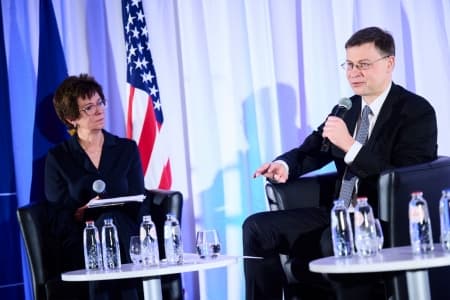
The conference closed with a fireside conversation between Ambassador Katherine Tai, US Trade Representative, and Valdis Dombrovskis, Executive Vice-President for an Economy that Works for People, European Commission. EVP Dombrovksis is also the winner of this year’s Transatlantic Business Award. They covered a range of issues, including the recent transatlantic response to the invasion of Ukraine, the next deliverables for the Trade and Technology Council, ways to further advance the EU-US partnership and the need for overall transatlantic cooperation based on common values.
Related items
:focal())
News
3 Dec 2025
Meeting with Deputy Secretary Landau to advance transatlantic cooperation
On Tuesday, 2 December, AmCham EU took part in a roundtable discussion with Christopher Landau, US Deputy Secretary of State. With the implementation of the EU-US Framework Agreement moving forward, the discussions focused on building a more stable and competitive transatlantic business environment. Participants discussed the importance of an open Single Market and the urgency to move ahead with the EU’s work on simplification. The exchange also underlined the value of the transatlantic marketplace as a springboard for American companies to compete globally. Strengthening the partnership makes both sides more resilient and better positioned to respond to strategic challenges, including those posed by non-market economies.
:focal())
News
21 Nov 2025
AmCham EU meets with Ambassadors Greer, Puzder and White
On Friday, 21 November AmCham EU joined Ambassadors Jamieson Greer, United States Trade Representative, Andrew Puzder, US Ambassador to the European Union and Bill White, US Ambassador to the Kingdom of Belgium. During the discussion, Malte Lohan, CEO, AmCham EU voiced strong support for the EU-US Framework Agreement, which offers the best path to improve the trade and investment climate, while addressing concerns about the economic impact of broad tariffs. AmCham EU continues to support other key parts of the deal, as well as calling on the European Parliament and Council to quickly adopt the Commission’s tariff reduction proposals with minimal changes.
:focal())
News
9 Nov 2025
Tackling competitiveness with our Executive Council
Urgency around simplification, predictability for businesses and the growing disconnect between political narrative and business reality were centre stage during AmCham EU’s Executive Council (ExCo) Fall plenary on Monday, 3 and Tuesday, 4 November in Brussels. With a view from the boardroom of some of the largest companies invested in Europe, the senior leaders emphasised how complex and overlapping rules are making it harder to plan, invest and grow in the region. They stressed that the current focus on adding new requirements is not matched by efforts to reduce or align existing ones. The result is a business environment that feels increasingly unpredictable, despite policy goals aimed at growth and competitiveness.
Julie Linn Teigland, Chair, Executive Council, AmCham EU, said: ‘The ExCo was encouraged by the earnest and determined focus of simplification agenda and how both Commission and Council are putting competitiveness at the centre of EU policy making. The way forward is to set ambitious goals and deliver on them. We truly believe that Europe has the right capabilities and potential to stay an attractive place for investment, growth and innovation.’
In meetings with senior EU and US officials, including Ambassador Carsten Grønbech-Jensen, Permanent Representation of Denmark to the EU; Ambassador Aingeal O’Donoghue, Permanent Representation of Ireland to the EU; Ambassador Andrew Puzder, US Mission to the EU and Björn Seibert, Head of Cabinet to European Commission President Ursula von der Leyen, the group of business leaders reinforced the call for clearer, more consistent regulation and a renewed commitment to strengthening the Single Market. Underpinning the discussion was the need for progress on the EU-US Framework agreement, one that provides a path to predictability for businesses.
Europe must act now to safeguard its competitiveness. That means cutting complexity, ensuring policy matches business reality and deepening ties with trusted partners. If Europe wants to lead on innovation, sustainability and security, it must first be a place where business can thrive.
Policy priorities
Insights and advocacy driving Europe’s policy agenda. Our priorities support growth, innovation and a stronger transatlantic economy.
Membership
Connecting business and policymakers to strengthen the voice of American companies in Europe.